Tampilkan postingan dengan label Georgann Eglinski. Tampilkan semua postingan

Rabu, 28 Juli 2010

Document Print and Reproduction: Magnolia

Document Print for Magnolia in Arnold's Attic
The packages Arnold has sent me over the years are filled with swatches and notes. The print called "Magnolia" has a paper tag that Arnold stitched to it:
"When washed the background faded to a purple and the green in the leaves to a bluish shade."
Dyes were unreliable in the era when his Aunt Alice was buying cotton prints like the one above. The mills were experimenting with new test-tube formulas and the new shades often changed color or completely disappeared after washing or a few hours of sunlight.

I don’t know the original color in those decorative little leaves but I loved the shade of blue we see now. The blue became one of the basic colors in the collection. We added a pinstripe to the background in the print for more detail and printed it in two blues, Augusta red and Minerva green. Those color names and the print name Magnolia come from the townships, the county and other places in Arnold's neighborhood.


One hundred years later our test-tube dyes are a lot more reliable, but I think the document print's fading above was a happy accident. Below a quilt using the blue colorways in Arnold's Attic


Ohio Autumn by Georgann Eglinski

Georgann used charm packs and yardage to make this four-patch strip quilt.
The precut packages are in your quilt shops now.

Jumat, 07 Mei 2010

Ragtime


Ragtime by Georgann Eglinski, 2009.
Quilted by Lori Kukuk

Here are some pictures of Georgann's strip quilt that
she showed at the Kaw Valley Quilters Guild show in April.

Georgann has made several quilts in this pattern, a good combination of simple patchwork and fancy fabric.

She took her palette from a reproduction print line called Ragtime
that Terry Thompson and I did for Moda in 2005.


Ragtime reproduced some crazy prints from the ragtime era, the 1910s.
People sometimes have trouble believing these "black novelty prints" could be 100 years old.
(Not all reproduction fabrics are brown---see my last post)


These bright on black prints were very fashionable about 1910.
Above is a stereograph photo with a quilt top that was the inspiration for the Ragtime collection.


Vestibule or Morning Star
Susan Stiff at Moda did a digitized version of the old quilt top in the new fabric.


Here's a version I made of the Morning Star I made with the charm pack and some extra yardage. See a free pattern for Vestibule or Morning Star on the home page of my webpage (lower right)


We did a  little package called a Tin Box Sampler that featured a charm pack of small squares and a disk with patterns on it.

Here's an applique design from the Tin Box.


Your quilt shop might even have a few yards of the Ragtime reproduction left, or I bet you can still find Ragtime prints at your favorite online source. Just do a digital search for Ragtime Moda.

Kamis, 04 Maret 2010

Tracey Brookshier & Friends


Daisy Star by Tracey Brookshier

Among the  most innovative pattern companies today is Tracey Brookshier Design Studios.
Here's an artist statement from Tracey a few years ago:

I am inspired by antique graphic quilts with strong lines and repetitious forms. My quilts are original, though some are based on traditional block patterns. Fabric always drives the design - I buy something wonderful and figure out how to use it in a way that pleases me. I want viewers to say ‘Wow!’, when they see one of my quilts on a wall.


Crystal Lattice by Tracey Brookshier

She designed one of the most successful patterns ever. The rest of us pattern designers can only sigh when we look at the numbers---thousands and thousands of Bento Box patterns1 and 2 have been sold. But her success is well deserved.

Tracey doesn't design all her patterns. Here are two designed by friends:

Sudoku designed by
Susan Maynard Arnold
Sue Arnold realized you could translate a Soduko puzzle to 9 fabrics.


I pirated this picture of Sue from the site of the East Bay Heritage Quilt Guild.
Suduko with 9 fabrics on the right, with 16 on the left.

Sudoku
by Georgann Eglinski

Georgann's been making Sue's Sudoku quilts of Japanese fabrics.
 She cut leaves out of a print and appliqued them atop the version below.


Tracey's also published a pattern from Miriam Nathan Roberts's series of Interweave quilts.


Rainbow Interweave by Miriam Nathan-Roberts


Interweave by Georgann Eglinski
Georgann took a workshop from Miriam and made this wall quilt.
"Value is the Key"

Tracey's patterns are so "wow"-inducing that people often make them but forget to give her and the artists credit.
(Isn't that a nice way of putting it?)

Check out Tracey's website and her patterns here:

And see Miriam Nathan-Robert's impressive work by clicking here:
http://www.miriamnathanroberts.com/

Sabtu, 06 Februari 2010

Jeckyll's Sunflowers


Thomas Jeckyll (1827–1881) was an English architect best known today for the metal work he designed. This pair of brass andirons is an Arts and Crafts classic that has influenced artists over the last century. Jeckyll also did at least one fence of these sunflowers. (There are two spellings of Jekyll's name. Pick your favorite.)


A detail from an andiron and 2 appliqued sunflowers


I designed and stitched the sunflower on the left with my first William Morris fabric collection and Pam Mayfield pieced and appliqued the one on the right with the second, The Morris Workshop. Buy the Arts & Crafts Sunflower pattern for $7.95 from Star books by clicking here:


Georgann Eglinski did two versions, one with a pieced sunflower


Above are two paper interpretations.
Left: a contemporary poster, the right one a reproduction wallpaper poster from Bradbury & Bradbury.


The Spencer Museum of Art owns a Jeckyll drawing.
See more of it by clicking here:

See a rail from Jeckyll's fence in the collection of the Victoria and Albert Museum:
See more Bradbury & Bradbury wallpaper at their site:

See a black & white picture of the andirons (firedogs) that are now in the Freer Gallery by clicking here:
And read about the Freer's Peacock Room, for which they were designed, by clicking here:

Susan Weber Soros and Catherine Arbuthnot have written a book about Jeckyll.


Arts & Crafts Sunflower by Pam Mayfield, 42" x 16"

Selasa, 24 November 2009

Indigo Prints: Resist and Discharged Figures


Julie in Tennessee sent me blocks removed from an old comforter cover. She'd received them from a friend who was a member of the Shields family of Cades Cove, Tennessee. The pattern is one I haven't seen.
The blocks look to be from 1890-1920 when indigo prints were relatively inexpensive and very popular with quiltmakers. They show typical indigo coloring with a dyed blue background and white figures, style dictated by indigo's chemistry. Indigo will not color if it is exposed to oxygen, so simply applying indigo to a wood block or copper plate does not work because the dye binds with the oxygen in the air.


Here's a date-inscribed quilt from an online auction with indigo blue as the ground and white figures in the print. It's a typical early 20th-century factory printed indigo.

Printers traditionally print white figures on indigo grounds in a reserve or resist process (also called batik) by applying wax or a resist paste in a pattern on the fabric and then dipping it in the indigo dye vat. When the paste is removed a white on blue design appears. Another technique developed about 1800 involves dyeing the fabric blue in the indigo vat and then printing a discharge paste to bleach out the figures. The prints in the Cades Cove blocks and Aunt Celia's quilt are probably done in a sophisticated variation of the discharge technique (although the pattern design is rather unsophisticated).
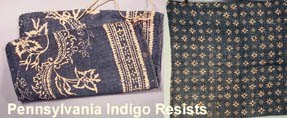
The indigo resist process has been used by artisans all over the world. Pennsylvania historian Trish Herr has been collecting early indigo resist prints from the Germanic people there. These are hand printed rather than factory printed.


And Japanese printers still dye in traditional fashion.

This quilt is called Japanese Coins, made by Georgann Eglinski from Japanese fabrics, 2009.

Printers figured out ways to reverse the figure/ground appearance in indigos. The earliest technique was the labor-intensive process of applying resist paste to the background and leaving the figures to absorb the dye. These indigo resist prints are sometimes called China blue prints because they look like a piece of porcelain.

Elizabeth Richardson Collection. Western Kentucky University Library

Above: a scrap of old indigo resist with blue figure and white ground from quilt historian Florence Peto's collection. She gave it to collector Elizabeth Richardson several decades ago. Recently, quilts, correspondence, and scrapbooks belonging to Elizabeth Richardson were donated to the Western Kentucky University Library. The note says "Very old blue-on-white resist print. F. Peto. For your collection. Happy Easter!"

Here are some reproduction fabrics imitating China-blue style with blue figures on white grounds.


A sofa upholstered in indigo-resist reproduction from Ikea

To see more reproductions do a websearch for the words: fabric indigo resist.

To see more about the quilt collection at Western Kentucky University click here for their online exhibit

And see how indigo yarn is dyed in a recent dyeing workshop in the Navajo nation by clicking here:
Related Posts Plugin for WordPress, Blogger...

LinkWithin