Tampilkan postingan dengan label Arnold's Attic. Tampilkan semua postingan

Kamis, 27 Januari 2011

More News From Arnold


Arnold is recovering from his heart attack last summer. He sent photos of a reception that a local quilt shop hosted in November to celebrate the Moda fabric collection named for him. Friends and neigbors came to say hi. This is his cousin Cheri who made him a miniature Christmas stocking from the selvages from the fabric line.


The shop is Angelics:
A Quilters Haven in Canton, Ohio

Many of you sent get-well notes after the heart attack. They were greatly appreciated. He sent well-wishers a handmade reply.

And I received a handmade Christmas card of antique prints.


Arnold's Attic came out last fall. It reproduces
 turn-of-the-20th-century prints from Arnold's stash in his attic.

Here he's sitting in front of a top made from the collection.

Here's a free pattern for this Ohio Star Puzzle.
 Click here to download a PDF.

I found another quilt made from Arnold's Attic prints
 at the Etsy store called Pieces of Pine.
If you still have your Jelly Roll strips this strip quilt
 would be a good way to use them.

Arnold says he's doing well. His many friends are glad to hear it.

Read about the heart attack at this September post.
http://siputflash.blogspot.com/2010/09/news-of-arnold.html

Selasa, 16 November 2010

Arnold's Attic Woven Plaids and Stripes

My Arnold's Attic collection for Moda includes woven plaids and stripes inspired by the subdued greens, blues and red-browns in the print line.


This photo of the fat quarter bundle is a little too intense.
See the swatches above for a truer blue.


We see woven pattern in quilts going back to the 18th century.
The hexagon above dates to about 1840. 

Plaids, stripes and checks were extremely popular in the years 1880-1920, the years when the fabric in Arnold's Attic was collected by his relatives. The bowtie top is from my collection, about 1910. Blacks, red and indigo blue were the fashion.

In America's Printed Fabrics I wrote about woven plaids and stripes and their popularity with quiltmakers after the Civil War.

"After the War, the ruined South had few assets besides future cotton crops. Realizing that the traditional system of trading raw material for manufactured cloth could never guarantee prosperity, a few Southern entrepreneurs decided to build mills to clean, spin, weave and color the cotton. Among the most successful was Edwin Holt and his family.
Holt established an empire in 1837 with his first mill in the area near Chapel Hill, now Alamance County, North Carolina. After Appomatox, Holt was determined to rebuild a Southern economy based on industry and capitalism rather than agriculture and slavery.
Southern mill owners did not print the finer figured calicoes that required skilled printers, but focused on plaids and checks dyed in the yarn stage, then woven into pattern. The Southern plaids and checks, which became known as Alamance plaids, were the standard stuff of everyday clothing and household textiles in the South through the end of the century. Scraps of the Southern plaids wound up in many quilts and numerous quilts survive with backings of Alamance plaid.


A Log Cabin with a back of Alamance plaid.
The plaids were often flannelled or combed,
giving a soft feel for quilt backs and a warmer surface for clothing.
March 8, 1870
“Cotton spinning has been paying very well this year….and I expect making money fast on checks….there is more money in checks than anything else and no end to the demand.”
Letter from Thomas Holt
Detail of a Log Cabin dated 1914
Log cabin quilts were often made in plaids, Among my favorites are those with plaids and stripes cut on the bias, which works pretty well since the block is built on a fabric foundation.

I'm planning a log cabin cut from the Arnold's Attics plaids. I've digitally recolored antique examples for inspiration.


I'll be putting some of the plaids on the bias.

But I won't try to revive the fashion for men's suits.

October 4, 1886
Charlotte, North Carolina
“I one day saw a country merchant from Gaston, North Carolina higgling with a Charlotte dealer over a piece of Yankee plaids at 7 cents per yard. In a few minutes I saw the president of the McAden mill clad in a full suit of his own beautiful goods far superior to the other at 6 1/4 cents per yard.”
See more about Alamance County plaids by clicking here:
http://www.textileheritagemuseum.org/Textiles%20and%20Alamance%20County.htm

And check Rosie the Fabric Shopper's blog for her review of Arnold's Attic plaids:
http://fabricshopperonline.com/arnolds-attic/

Rabu, 20 Oktober 2010

Document and Reproduction: Rose and Repeat


Document print for Rose
in my Moda collection Arnold's Attic

Here's a swatch from Arnold's Attic. He cut it from an old skirt that his great-great grandmother Mary Barbara wore in the 1890s when she was about 65 years old. You can barely see a seam on the right side of the swatch, indicating it was cut from a garment.

Arnold noted it was a Balmoral skirt, a style of full skirt fashionable in the 1860s. Mary Barbara probably wore the fashions of her youth late into the 19th century. A black print with a purple figure---conservative in color, yet fashionable in design---would have been appropriate for a lady on the shady side of middle age.

Arnold actually sent two swatches; the one stitched to the note is a fabric scrap leftover from the dress. It's brighter purple than the cotton that survived in the acutal garment, so Mary Barbara's original dress was a touch more flamboyant when she first wore it.

We used neither black nor purple in the Arnold's Attic reproduction collection but the print is perfect for the time period so we offer it in three colorways reflecting the autumn tones. The print name is Rose.


Women about 1880
Women didn't often have their pictures made with their aprons on. The apron fronts are pinned to the dress in typical fashion. One woman wears a stripe; the other a floral with a regular repeat that includes space between the figures and larger figures than would have been popular in the 1860s.

How is Mary Barbara's print perfect for later in the 19th century?
There are a few design characteristics. One is the naturalness of the drawing. Rather than a mere suggestion of a floral as in the reproduction from the mid-19th-century below, the figure in the Rose print is realistic enough that we might recognize it as a wild rose. It's a natural image whereas the figure below is just a suggestion of a floral, what was sometimes called a mignonette (a cute little thing).

Corn Shuck Hat from Civil War Homefront

This print from my Civil War Homefront collection with small floral mignonettes was the fashionable style when Mary Barbara was a young woman in the 1860s. One name for this formal grid style is a foulard print.
Another important style characteristic in fabric is the repeat, how the figure is formatted into identical motifs. All printed yardage requires that the pattern be repeated in regular fashion. The individual figures must fit into an overall pattern, which is sometimes obvious as in the Civil-War-era pattern above with a simple half-drop repeat. Each little figure is dropped next to another half way down. The overall look is a regular diagonal grid, a style of repeat that was hot in the 1860s.

Madonna print in Avon Brown

By the 1890s the fahionable repeat style was what textile designers call scattered. The repeat, like the floral figures, should look more natural than formal. The florals above are repeated in regular fashion, but not so obviously as in the foulard. Tricks to make the repeat look more natural are to add more space between the figures, and to flip and rotate the figures.


Magnolia print in Augusta Red


Joyce sent a photo of a wallhanging she made with the Arnold's Attic prints. Note how the different repeats catch your eye in different fashion. The rather formal leaf print on the outside border contrasts nicely with the loose curve in the patchwork.


Designing a fabric collection means offering several styles of repeat for contrast. Designing a reproduction collection means offering more regular foulards for an 1860s line and more scattered repeats for an 1890s line.

For more on repeat and how designers do it click here to see the Design Sponge blog:


Marit's posted a photo of a candlemat she made with a charm pack of Arnold's Attic
See her blog here:
See more about the Arnold's Attic collection by clicking here:

And check your local quilt shop for Arnold's Attic. Usually, shops have a hard time reordering designer prints but tell your shop owner that Moda has notified me there is lots of Arnold's Attic available for re-order.

Arnold's Attic in a strip quilt by Georgann Eglinski

Rabu, 06 Oktober 2010

Kit for Arnold's Attic

Arnold's Attic Medallion
Designed by Barbara Brackman and Susan Stiff


The kit for the Arnold's Attic Medallion arrived from Moda the other day.


It's a nice package. Here's what you get:
 Fabric for the quilt, backing, a copy of Quilters Newsletter with the pattern in it and three labels.


The labels: a care label, a larger label for you to ink and one that says "Made by hand, stitched with love."

I like the Don't Agitate Me suggestion on the black label.
I might put that label on the back of my sweatshirt.


And on the topic of agitation---There's an error in the pattern in Quilters Newsletter. (This NEVER happens.)  Editor Angie Hodapp explains what went wrong at this post:

The bad news is the numbers for piece I are wrong.
The good news is you don't need piece I.

Sabtu, 04 September 2010

Document and Reproduction: Sparta

Document

The document print for the Sparta fabric in my Arnold's Attic collection dates to about 1880-1900. I called it Sparta after a place name in Arnold's neighborhood.

It's an eye-catching print---little shredded wheat bites and pink commas floating on a carmel-colored grid. So modern looking it's hard to believe it's 1880.


That combination of brown and bright pink was hot in the 1880s.

When I am coloring a whole collection I have to think about the all-over effect, so I decided against the pink. And I changed the colors by greening up the tans and shifting the carmels to red so all the prints would go together as a group.


Reproduction

Above are the other colorways in the collection

Roseanne Smith fussy-cut the little spirals out for the inner points in her mariner's compass quilt.


It's a 4-Block quilt top made with paper-pieced designs in Arnold's Attic prints.

More on Sparta:
After I received the fabric I realized I'd seen that reprint before. Somebody else reproduced it a few years ago. What the heck! It's a great print.

Minggu, 22 Agustus 2010

Document and Reproduction: Cretonne

Document print for "Ohio Autumn", a cretonne from Arnold's attic

"Ohio Autumn" recolored for Arnold's Attic

Cretonne, a word once common in the American female vocabulary, is now obscure. I first heard it in the 1970s when I was teaching quilting in Chicago. I suggested the students buy some large-scale prints to contrast with their calicoes. An older woman glared at me: "I'm not putting any cretonne in my quilts."


Bronze-shaded swatches on top of a cretonne quilt back.

She pronounced it CREE-tawn with the emphasis on the first syllable and explained that cretonne was a cheap print, prone to fading and too coarse a weave for patchwork. She was talking about the furnishing fabric she grew up with, inexpensive large-scale prints that were used to cover footstools, drape the kitchen sink and tie into whole-cloth coverlets.


Photo by Lewis Hines, about 1910, of a family making paper flowers.
Collection of the Library of Congress.
The cretonne-draped clock shelf on the right was a common feature of interior decorating.
Hines, documenting child labor, viewed these New York City apartments as dreary but the women's use of fabric for inexpensive decorating was often very up-to-date.

The name cretonne seems to have come into use in America in the 1870s, as a synonym for chintz. Large-scale prints, the European chintzes that had been so popular in quilts made before the Civil War, came to be "chintzy" in the eyes of tastemakers. Quilters focused on calicoes, the small-scale prints so popular in the log cabins, charm quilts and scrap quilts of the late 19th century.


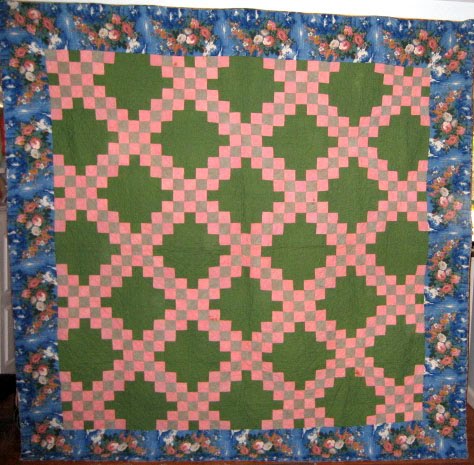
Irish Chain with a large-scale print as a border, 1870-1910?.

This quilt is a little odd in its mixed styles and hard to date from the little photo in an online auction. The ordered patchwork design pieced of bright calicoes with no neutral was popular at the end of the 19th century, particuarly in southeastern Pennsylvania. But the use of the large-scale cretonne for a border is quite old-fashioned.

Is that blue fabric a European chintz or
a later domestic cretonne imitating an earlier color scheme?


Larger-scale fabrics remained widely available. Cretonnes were the "proper thing for draperies, hangings, furniture covering, etc." according to the Sears catalog. The name cretonne (pronounced cruh-TAWN in imitation of the French word) is derived from Creton, a French town that had specialized in manufacturing a coarse cloth made from hemp.
Tintype of a boy on a cretonne throw
about 1870


In 1889 Chambers Encyclopedia defined cretonne as
"originally a white cloth of French manufacture…now applied to a printed cotton fabric used for curtains or for covering furniture, which was introduced about 1860. Chintz, so much employed for the same purpose in former years, is a comparatively thin printed cloth usually highly glazed. Cretonne, on the other hand, is generally thick and strong for a cotton fabric, and with a twilled, crape, basket, wave, or other figure produced on the loom. When a pattern is printed on this uneven surface (it is sometimes plain), it has a rich, soft appearance. A cretonne is rarely calendered or glazed. The thick weft threads of inferior qualities are commonly formed of waste cotton, and the patterns upon these, though often bright and showy, are as a rule printed in more or less fugitive colours."
Cabinet card of a girl and a cretonne wholecloth cloverlet
about 1890

In a 1918 definition, chintz was described as the English word and cretonne as the French word for drapery prints. The reality may be that cretonne as a name for inexpensive cotton furnishing prints is a Frenchification that elevated mundane goods to a more sophisticated level, much in the way that those of us who buy our wardrobes at Target or J. C. Penney pronounce the stores' names with a French accent when asked where we shop.

The arc of taste swings between clutter and simplicity. As modernism dictated austerity one magazine advised in 1919:

"Cretonne curtains are used by interior decorators in rooms where odd chairs are covered with various patterns of cretonne, but this treatment requires a most experienced eye. A motley color scheme is best avoided by the average home decorator. Even when beautifully harmonized by an expert, the use of a number of colors and patterns becomes tiresome in a short time as plain effects never do."

Plenty of cretonne crates a "motley color scheme" in an 1897 stereo card studio.

Cretonne was old-fashioned then, but that's why we love it today.

For more about cretonne see my book Making History: Quilts and Fabric 1890-1970.
http://www.ctpub.com/productdetails.cfm?PC=1212
Related Posts Plugin for WordPress, Blogger...

LinkWithin