Tampilkan postingan dengan label Carol Gilham Jones. Tampilkan semua postingan

Sabtu, 20 November 2010

Sweetheart Quilt


Winnie writes with a pattern identification question:

This top was given to my aunt to be hand quilted.  The top was completed years ago, so I'm told.  She and I have looked through multiple books and on line but just can't find a name for this block.  I would greatly appreciate your help.


Sweetheart Quilt by Capper's Weekly

Friendship Quilt by the Kansas City Star in 1938
 
A Heart for Applique by the Kansas City Star in 1951


I went to my Encyclopedia of Applique, found the one-page category named "Four Hearts"

and there it was. It seems to have been published at least three times:
I asked Winnie if I could post a picture of her Sweetheart Quilt; I'm always so glad to be able to identify a mystery.
Detail of Sweetheart Quilt, 1930-1950

....and see how this design was actually stitched. It seems to be appliqued using a small running stitch in black thread.  The little sketches I indexed for the Encyclopedia made the construction a bit of a mystery too. But in Winnie's example I can see it's a tile quilt. There wasn't much published about tile quilts---at least until recently.


Carol Gilham Jones and Bobbi Finley published a book this year called Tile Quilt Revival: Reinventing a Forgotten Form.

It's a 19th-century technique, rather rare, in which fabric shapes are appliqued to a white background and the background shows through as sort of the grout in a tile wall. The quilt below is from 1860-1890, done mostly in wool and wool combination fabrics like challis appliqued to a white cotton ground.

Tile Quilt 1860-1890


Here's a contemporary version of a tile quilt block from Carol's blog Free to Bee. Click here:
http://carolgilhamjones.blogspot.com/


Tile quilt by Carol and Bobbi

See Bobbi talking about historical tile quilts by clicking here:
http://www.youtube.com/watch?v=bGFAxPzmYxw

And see these blog posts about tile quilts
http://www.weewonderfuls.com/2010/07/im-reading-about-tile-quilts.html
http://lucyquilting.blogspot.com/2010/06/tile-quilt.html

It would be fun to see Winnie's quilt from the 1930s done in new prints.

Selasa, 20 Juli 2010

Document & Reproduction: Arnold's Attic

Brown and bronze combinations,
 reproductions from Arnold's Attic from Moda.
The prints reproduce style from the 1880-1910 period.

Choosing colors for a reproduction fabric collection involves copying the shades that old dyes created.
Arnold's Attic echoes fabrics that Arnold inherited from his Aunt Alice, who collected prints over 100 years ago.

Browns combined with blues, pinks and khaki shades.
Color inspiration for Arnold's Attic.

The dyes that created these brown prints were synthetic, created in test tubes, rather than the older natural dyes like madder and quercitron that also dyed cotton shades of brown.

A few prints from 1880-1910 from my collection

It's not the individual colors that were so innovative in the 1880's but the color combinations.


The new dyes allowed the designers to easily put khaki greens, salmon pinks and brick reds side-by-side  like the document print above.

Aunt Alice seems to have loved the new shades. Many prints in the bronzey greens and browns have survived in the boxes in Arnold's attic. One of the most innovative combinations was steel blue with earth-tone greens and reds.

I've tried to recreate that color combination in the Arnold's Attic collection. I called the blue Alice blue after Arnold's aunt. (The original Alice blue was named for President Theodore Roosevelt's daughter.)

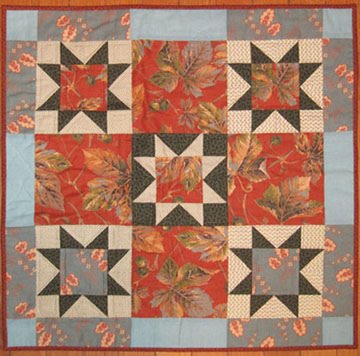
Ohio Autumn print from Arnold's Attic in Alice blue.

Carol Gilham Jones made a small star quilt featuring the blues and oranges. She added a solid blue to coordinate with the Alice blue prints in the collection.

Senin, 31 Mei 2010

Quilts and the Modern Movement


Joan Crawford in Letty Lynton, 1932.
Dress by Adrian. 

Movie set and costume design introduced modern emphasis
 on line, shape and contrast into American taste.
Adrian's dresses often included flat geometric shapes.

Modern is a strange word in that it means both current and past at the same time. Modernism was an early 20th century art movement---modern is up-to-date.


Carol Gilham Jones, Free Form Circles, 2008
Simple geometrics repeated---a hallmark of Modernism

The most up-to-date thing in quilts today is the Modern Quilt. Yet we can look at the trend as a reflection of the past---a movement that has roots in the early 19th century when the "modern era" began---the years of the industrial revolution and political rebellion against traditional religion and monarchic states.


Rain, Steam & Speed: The Great Western Railway, 1844
by J.M.W. Turner (1775-1851)

New attitudes about art accompanied new concepts in science and philosophy. Artists who had used tools of line, shape and color to imitate nature now saw line, shape and color as valuable in themselves. J.M.W. Turner's 1844 painting above abstracted the new railroads into rain, steam, speed, color and line.

Cocktail by Gerald Murphy, 1927
Oil painting

The modern art movement in the early 20th century emphasized shape and flat planes of color.

Elektrische Prismen, by Sonia Delaunay, 1914
Oil Painting

European designers like Anni Fleschman Albers and Sonia Delaunay adapted modern design to textiles.

Weaving by Anni Albers, 1926
Modernists looked to folk arts like stencilled decorations and folk weavings for inspiration. Folk art and ethnic arts took on new value as artists imitated their use of color and abstraction.

Detail of a log cabin quilt, about 1880


Chinese Coins, about 1900
We can imagine how fresh these 19th-century American quilts must have looked to people who grew up in the visual clutter of the Victorian era.

Patchwork 1908


Reel quilt, about 1850

Mennonite sawtooth medallion, about 1900

Detail pieced floral about 1850

It's easy to find parallels between 20th century modern art and 19th century quilts, but it isn't coincidence. Modern artists found much inspiration in folk arts.

Find inspiration in Anni Albers weavings at the Albers Foundation:
Read more about Sonia Delaunay's textiles at the Textile Blog

Read more about modern quilts in my February post:

Fleamarket Fancy by Denyse Schmidt
About 2005

Senin, 11 Januari 2010

Tile Quilt Revival


Lotus, Bobbi Finley
Carol Gilham Jones and Bobbi Finley's new book Tile Quilt Revival: Reinventing a Forgotten Form is in the quilt shops now. I wrote an introduction and got to include some photos I took of the tiles of Catalina Island.


Tile Quilts are a cross between applique and crazy quilts in which the backing fabric, the grout shows.


Starry Orange Peel, Bobbi Finley and Carol Gilham Jones
An interpretation of an antique quilt.


Here are two that aren't in the book.


Charles and His Favorite Things by Carol Gilham Jones


This fused portrait of Carol's husband also contains a portrait of Carol and their lovely dogs Grace and Sumo. The late Sophie is also on there.


All in the Family, Bobbi Finley and the Glory Bee, Williamsburg, Virginia, 2008

Bobbi is a cat person

The Road to California quilt event in Ontario, California will have a special exhibit of quilts from the book. Look for their show if you are going to Road to California at the Ontario Convention Center January 14-17. Read more about the exhibits here:
http://www.road2ca.com/exhibits.html

Read more about the book Tile Quilt Revival here

http://www.ctpubblog.com/2009/11/04/sneak-peak-tile-quilt-revival/

See a few antique tile quilts by clicking on these links:
Cowan Auctions sold a terrific example several years ago. It's in the collection of Colonial Williamsburg now.

Woodard & Greenstein show a pair of tile quilt blocks.

Laura Fisher has a wool tile quilt on her website. It's appliqued shapes covered with embroidery.

And see a tile applique inspired by the book at Brandy B's blog

Related Posts Plugin for WordPress, Blogger...

LinkWithin