Tampilkan postingan dengan label reproduction fabric. Tampilkan semua postingan

Selasa, 18 Januari 2011

Madder Style Prints

Star quilt with madder-style setting blocks and border
 1840-1860
In the quilt above, the quilter combined indigos, Prussian blues and other fashionable fabrics with madder-style prints in the blocks. Madder browns have an unfortunate tendency to deteriorate or "tender" fabrics. The darkest brown in the quilt above, mordanted with iron, has oxidized, leaving large holes where the dark stripes were. The batting is showing through.


A detail of the star quilt.
 It's an interesting quilt because of all the mismatched strips added to the triangles to make them fit. And doesn't that madder-style print at right look like tiny rotary cutters???


Madder-style prints were popular for clothing and quilts---
the fabric of everyday mid-19th-century life.


These young women photographed with their books
in the 1860s are wearing prints that might have been dyed with madder.

Cottons dyed with madder are among the most common fabrics in nineteenth-century quilts. Madder pleased both mills and customers because it was colorfast and inexpensive, yet versatile.
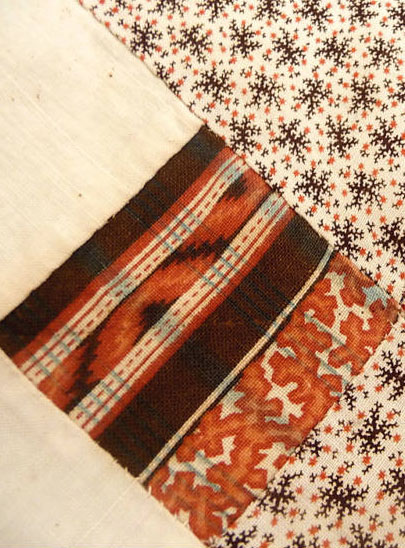
Dye from madder root could produce the bright orange,
the paler and duller oranges and the chocolate browns in these prints.

The calico printer treated the yardage with different mordants (metal salt solutions such as iron or aluminum) and dipped the cloth in a single dye bath made from madder root. Each mordant reacted differently with the dye, producing colors ranging from red-orange through purple, brown, and almost black. The madder coloring agent would not bind to areas that were not mordanted.


Madder is a vegetable dye derived most efficiently from a perennial plant with the Latin name of Rubia tinctorum. Like many dye plants, it is an Asian native. Pliny the Elder, a Roman naturalist who traveled to Asia in the first century AD, described the amazing transformation of a piece of cloth treated with colorless mordants emerging from the dyebath in a rainbow of shades. The plant and its secrets traveled to Europe where madder thrived in Italy, France, Holland, and Spain. Other names for the dye are al izarin in Arabic and garance in French.

Madder produced a plum colored purple known as puce.

Madder was particularly popular with quilters between 1840 and 1890.

Madder dyeing produced a brick red or orangey-red,
not the bright red that the Turkey red process did. The browns tend toward reddish.


Photograph from the late 1850s(?)
A print skirt and a big dog.
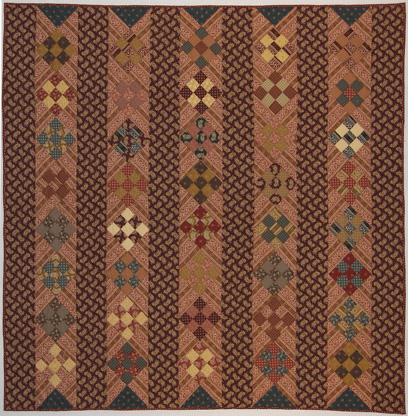

Reproduction Quilt
Sorghum Taffy Strip Quilt
made from my Civil War Homefront collection from 2009.
Blues and honey-colored yellows accent the madder-style prints.

Prints from two Moda collections: Civil War Homefront and Civil War Reunion

In my latest Moda reproduction collection Civil War Reunion I've colored several prints in a Dusty Rose colorway with an authentic madder orange. It's a shade to buy when you see it as the color so popular in 1860 might not be available in the future.

Rabu, 12 Januari 2011

Document and Reproduction: Union Print


It's always a thrill to come across a piece of patriotic fabric. This one in madder colors may date to the actual time of the Civil War but it's also likely to date anywhere from 1861 to 1890. After 1890 madder-style colors became old-fashioned.


The Grand Army of the Republic was the name
 of the Union Army veterans group.
Notice the GAR poster in the window in this postcard about 1910.


The print may have been associated with the War as a patriotic Northern image or it may date from the  Centennial in 1876 when numerous patriotic prints were made to celebrate the re-union of North and South.


For my Moda collection Civil War Reunion we copied the madder orange colors in the original and re-colored it in bright blue and buff shades as well as madder brown and madder red.


I hope to find re-enactors making clothes for toddlers and shirts for soldiers from this print.


A "Living Flag" at a Union Army veteran encampment in 1908
The black and white photo of people wearing blue and red has been recolored.

We would be unlikely to find a similar print for the Confederacy as the North had the printing factories, while the South had the raw cotton.


Here's another patriotic print we reproduced a few years ago.
The original was in a top from the 1840s or '50s.


And this one was in a block cut from an antique quilt that had fabrics from about 1840 to 1880. Notice the flag stripe in the brown triangles. Three of those are the document print and one (the darker one is the reproduction.) The original is probably from 1876.

See more about Centennial-era patriotic prints in this post:

Rabu, 05 Mei 2010

Brown: In and Out of Fashion

Lost Ship by Barbara Brackman, 2002

Bonnie bus asked:

How did repro fabric get to be so brown?


Unknown pattern, about 1890

Antique quilts were brown. There was a real fad for brown calicoes from about 1860-1890.

From my book America's Printed Fabrics 1770-1890:

Historian Lewis Mumford called the last years of the century The Brown Decades. “The color of American civilization abruptly changed. By the time the [Civil] war was over, browns had spread everywhere: mediocre drabs, dingy chocolate browns, sooty browns that beiged into black.” His perspective, looking backward, reveals a twentieth-century disdain for the color, but in the gilded age, the era of brownstone buildings, walnut furniture and chestnut-haired beauties, brown truly reigned.


We see two main shades of brown in the 19th-century color palette: reddish brown and greenish brown.


Sawtooth variation, about 1875 from Cowan's Auctions

Many of the reddish-browns, the warmer brown  prints, were dyed with madder dye which produced dark browns, burnt oranges, peachy browns, tans, and cinnamon reds.
 
 
Madder-style prints were very popular from about 1860 to 1890, but we also see them in patchwork dating back to the 1780s.
 
The greenish-browns or khaki shades came from a synthetic dye that produced olive, bronze and cooler browns. This color palette appeared about 1875 and remained popular until about 1890.
 
 
Small star top using lavenders and bronzey browns about 1880
 
Pale blue and pink were often part of this bronze palette


 After 1890 brown was passĂ© and black, blue and gray quilts were the thing.
 
Four-patch, about 1910
 
When Mumford was writing about brown in 1931, it was considered hopelessly old fashioned. Quilters loved clear pastels and red and grayed green. But color fades in and out of style.

Hexagon medallion about 1940 from Laura Fisher

Brown quilts were again the thing in 1970. At the turn of the 21st century brown was the hot look in primitive, folky quilts.

Pomegranates and Berries by Jan Patek, 2008
Jan Patek's use of brown and her interpretation of antique quilts
has been quite influential in creating the "prim-folk look".
See her kit here:

In the central United States where I live everyone was crazy for brown--- brownish reds, brownish greens, flat blues, tan, tan, tan. There was no true white. We always said brown was a Christmas color. The brown fashion was one reason reproduction prints became so popular. The late-19th-century aesthetic shaped our taste.


Decorating magazine picture from about 1980


Union Square by Pamela Mayfield, 2001
Buy a copy of Pam's Union Square pattern here:

Taste changes and now everyone (like Bonnie) is talking color--- true, clear colors.


So all those browns, whether antique prints or turn of the 21st-century reproductions, might look dull to fans of chartreuse and shocking pink (a revival of the colors of the 1950s and '60s).

The brown color palette was just one style in the 19th century. There were plenty of other fashionable looks.

Basket about 1880

And today browns remain important as authentic reproductions. Without browns, reproduction quilters would be at a loss. Plus those toned down colors are a great decorating palette. Brown is a classic neutral that goes well with wood.


Browns from my current Civil War Homefront collection for Moda

Triple Nine Patch by me and the Sew Whatever group, 2003
The pattern for this and the Lost Ship are in America's Printed Fabrics, which has some lovely brown quilts and fabric on the cover.

Minggu, 07 Maret 2010

Designing Fabric

Moda boasts a variety of fabrics from a variety of designers. Each of us works in different ways. I wish I had the computer skills to generate a digital design or the painting skills to paint a croqui, pronounced croak-ee, the word for a painted fabric design, which comes from the French word for sketch.


Sandi Gervais paints her designs. See her blog Pieces of My Heart for insight into how she works.

http://piecesfrommyheart-sgervais.blogspot.com/2009/07/process-of-fabric-designing.html


Jennifer of Tula Pink generates her designs in the computer. These blog postings show how she works.

http://tulapink.com/2010/02/21/building-plume/
http://tulapink.com/2010/02/28/the-changing-of-the-guard/  

My skills are 1) hoarding, 2) sorting. I have a huge collection of antique fabric scraps so reproducing antique fabric is my niche at Moda. Most of the scraps came from my friend Joyce Gross. Others were gifts from collectors like Bets Ramsey, Katy Christopherson, Mary Sue Hannan and Arnold Savage. I also buy antique fabrics to fill holes in the collection and occasionally I come across an old top in terrible shape that I can unpiece.


The worn top I used for color inspiration and a few swatches for Civil War Homefront lies under the strike-offs, which are the first fabric proofs of the actual reproductions. The ones with the white dots wound up in the line. It is hard to choose.

Because I love to sort I have classified the swatches into notebooks by color, by figure style, by date, by subject matter. I keep the scraps in archival plastic notebook pages and move them around. One year I might sort them by era, another by dye. This keeps me entertained by the hour, the way my mother's button box used to.


When I think of a historical theme for a new collection I re-sort.


Archival baseball card holders work great for the small pieces.

Right now I am working on another Civil War line for the 150th anniversary year of the beginning of the War. I'm also doing a late 19th-century collection in fall colors like the scraps below. (You have to wait till summer to see that fall fabric.)


Once I choose a theme and fabrics that date to that era, I choose a palette based on historical colors. If it's Civil War-era the colors have to mimic natural dyes. I like copying late-in-the-century prints because I can have blacks and different greens, purples and other shades that came from test tubes.

The colors have to work across all the pieces in the collection---the hardest part for me, because I have to imagine how the purple is going to look as a background as well as the figure. If I were better at computer imaging I could actually see that but right now I have to imagine.


Strikeoffs of the reproductions atop a quilt block
 of the original for Poke Salad
in the Civil War Homefront collection.
I had several to pick from and chose based on authentic color palettes as well as considering how it would fit into the overall collection. The original fabric is called the document print.


I send the document prints to Texas, where they go on to Japan for design and Korea for printing. Most of the time I get them back a year or so later. I send a cut with just the minimum repeat in case I don't get the antique swatch back from across all those geographical and language barriers.

I've been taking a class in Photoshop but I imagine I will always work with the actual swatches. That way I can justify shopping for antique swatches and storage space for all those notebooks.

Senin, 28 Desember 2009

Document & Reproduction: Printed Plaid


Carte-de-visite photo of a young woman from
 Willimantic, Connecticut, in the 1860s

Every Civil War reproduction collection needs at least one printed plaid. Plaids can be woven, that is the warps and wefts are varicolored and produce square checks and plaids. Plaids can also be printed onto plain cotton, a style quite popular in the mid 19th century. Below is one I called Sorghum Taffy from my Moda collection Civil War Homefront.


Left: the document print; right: the reproduction from
Civil War Homefront, both in madder-style shades


Tintype of sisters in matching dresses of probable printed plaid.
The narrow silhouette indicates fashion of about 1870.


Left: madder-style printed plaid from about 1840-1860; right: about 1870-1890


Left: a mid-century printed plaid; right: later in the 19th century.
Printed plaids, although more expensive to produce, offer an advantage over woven plaids. They can be printed on the diagonal, a style impossible with varicolored warps and wefts.


Woven plaid set on the bias in a top from 1840-1860
Woven plaids are hard to date. This 150-year-old plaid could have been bought at a fabric store last week.


Mid-19th-century printed  plaid (with a double pink)
Sometimes the only way to tell a printed plaid from a woven plaid is by examining the frayed edge of a swatch to see if the warps and wefts are dyed in the yarn or printed later. In this case it's hard to tell because the printed dye colored the edge yarns so well. While examining it with a magnifying glass I realized I could turn it over. A woven plaid would be identical on both sides. This is not. As Homer Simpson would say: "Doh!" Of course, examining the reverse is not possible when identifying fabric in a quilt.
Related Posts Plugin for WordPress, Blogger...

LinkWithin