Tampilkan postingan dengan label Victoria and Albert. Tampilkan semua postingan

Selasa, 25 Mei 2010

Sewing Diaries

Page from Barbara Johnson's album
or sewing diary

A sewing diary is a bound journal documenting fabrics, fashion and sewing projects. I've seen a few in museum collections and I know of a few you can see online.

They are personal swatch books with notes on when and where fabric was purchased, the price, what kind of dress was made with it and sometimes where the dress was worn.

Swatch book from a French manufacturer showing madder-style prints

They differ from swatch books or sample books like the one above in that sewing diaries are kept by the consumer. Swatch books are kept by the manufacturer as a record of what's been printed.

The Victoria and Albert Museum owns a sewing diary created by Barbara Johnson (1738-1825) who began her journal when she was 8 years old and continued pasting in swatches into her 80s. As you can imagine, it's a valuable record of cloth and fashion in the 18th and early 19th centuries.

Page from Barbara Johnson's book
At the top she's written:
"Blue and white spotted lutestring [silk] negligee [dress]. Eighteen yards. Three quarters wide. Six and sixpence a yard. Brother Johnson's Birthday."

View it in the V&A Museum's online catalog by clicking here:
http://collections.vam.ac.uk/item/O140029/album/

You can see she's pasted fashion plates and swatches into a used ledger. They call it an album. You can also classify it as a form of scrapbook.

The Museum printed a facsimile called A Lady of Fashion: Barbara Johnson’s Album of Styles and Fabrics in 1987. It cost about $100 new and now brings $200-$500. (This book is probably going to remain quite valuable as a collectible book.)


The fabric blog called True Up has a posting on Barbara Johnson's album.
http://www.trueup.net/?p=7179  

The American Textile History Museum in Lowell, Massachusetts owns several sewing diaries.

Click here to see one:
http://chace.athm.org/singleDisplay.php?kv=26059

Ann Eliza Cunningham stitched fabric samples from 1841 to 1890 and made notes on the pages.

On the ATHM page you will see in the lower middle of the page a blue line with the subject Sewing Diaries.
Click on that and several will come up.

Last year the Historic Costume and Textiles Collection at The Ohio State University displayed Susan Hunter Beall's album inspired by Barbara Johnson's. The exhibit called The Sewer's Art: Quality, Fashion, and Economy showed Beall's relatively recent records of her art.


Click here to read more:
http://costume.osu.edu/exhibitions/sewers-art/beall.php

Home economics teachers used to stress this kind of record keeping. Do any of you keep a Sewing Diary?

Jumat, 09 April 2010

More on Intarsia and Inlaid Applique


Quilted patchwork bed cover, England,
1690-1720, T.201-1984,
© V&A Images/Victoria and Albert Museum


The Victoria & Albert exhibit of quilts has inspired some discussion of the inlaid or intarsia technique, among the earliest types of patchwork. The quilt above has an estimated date of late-17th century to early 18th century. It is one of the oldest surviving examples of a patchwork bedcover.

See a two and a half minute slide show about the exhibit by clicking here:
http://news.bbc.co.uk/2/hi/entertainment/arts_and_culture/8578091.stm


Many early quilts feature areas of inlaid or intarsia applique.
See an earlier post about an exhibit just closed in Vienna with an emphasis on inlay work by clicking here:

Just what is intarsia? It's related to techniques in woodwork called parquetry, marquetry and inlay work and is done in much the same fashion, but patchworkers must add seams. Knitters also do intarsia work.

Jennifer Harris in Textiles, 5,000 Years: an International History and Illustrated Survey defined intarsia patchwork as "carefully cut segments of fabric…set into identically shaped openings cut in the ground fabric."


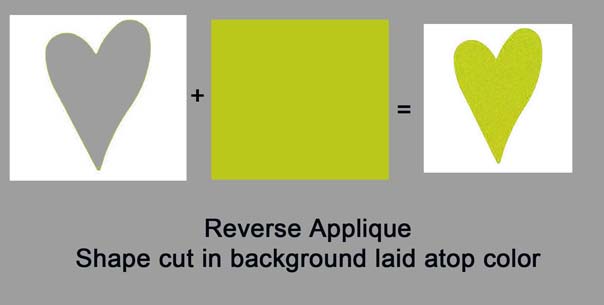
To clarify the differences in various patchwork techniques I drew some digital sketches. Say you want to create an image of a heart, a green heart on a white background square: 


You have many options. The most common solution today would be to lay a green heart on the white background and stitch it down. What we call applique.


We could piece it by adding seams to the background and seam allowances to all the pieces.

You might want to make a paper template for each piece and baste or glue the seam allowance around the paper, then whip stitch the pieces together. But most of us today wouldn't do this with the old-fashioned paper piecing technique.

Another applique option is reverse applique, a technique common with early 19th-century American quilters and 20th-century Kuna women in Panama for their molas, but a solution not often used today.


The patchworker of the 18th-century seems to have considered inlay applique as his or her first option.
One cuts the same shape in the white background out of the green foreground; inserts the heart in the heart-shaped hole and stitches them together.
In woodworking the carpenter cuts a heart in ebony and a heart-shaped hole in cherrywood exactly the same size. No seams, just gluing and sanding

But for fabric one has to add seams because you wouldn't want raw edges showing. People seem to have cut a paper template the size of the finished heart, added a seam allowance when cutting the green heart, and basted the edges of the green heart over the paper.
It seems to me that one would then use that basted heart as a template. Cut a piece of paper the same size as the background fabric. Draw as line around the heart. Cut a heart shape out of the paper. Use it to cut the heart-shape hole in the background fabric but add a seam allowance, which would make a smaller heart shape.
Turn that seam allowance under as you baste the white background to the paper.
Then insert the basted heart into the basted background and whip stitch them together. With perfect cutting and perfect basting they will fit perfectly.


Detail of a German piece in
a traveling exhibit about intarsia work
Some of these shapes are outlined by another piece of fabric, which is probably a way of dealing with the seam allowance problem, and another step.

Remove the papers if you get around to it.
Quilt it if you like. The piece at the top is quilted; the one below is not.


Here is a detail of a silk quilt dated 1718 that belongs to the British Quilters Guild.
See the whole quilt by clicking here:
The silk is shattering in places allowing us to see the white paper that remains almost 300 years later.

Learn more about intarsia by reading this book: Tuchintarsien in Europa

It's the 2009 catalog from a traveling exhibit from the Museum Europäischer Kulturen in Berlin. This show will be in Leeds, England at the Leeds Art Gallery from August 27, 2010 to November 1, 2010. Check it out here: http://www.leeds.gov.uk/artgallery  


And if you are not confused enough consider Charles Dickens's mid-19th-century discussion of patchwork in Household Words:

 Now, there are many kinds of artistic productions which we feel disposed to call patchwork, for alike reason : marquetry-patchwork, parquetry-patchwork, buhl-patchwork, niello-patchwork, damascene-patchwork, enamel-patchwork; and we can assure any person who has not duly thought on the matter, that these various kinds of patchwork often call forth considerable grace, taste, and delicate art.

Sabtu, 20 Maret 2010

Were You Invited?

Applique coverlet, cotton, Britain, about 1851,
 T.86-1957, © V&A Images/Victoria and Albert Museum

The place to be today is London for the opening day of the show at the Victoria and Albert Museum, Quilts 1700 - 2010.


Click here for information about the show:
http://www.vam.ac.uk./
 

Center, Sundial Quilt dated 1797

Actually the place to have been was the preview party on Wednesday. If you weren't invited you might want to check out these blog entries by people who were. Get a sneak preview.


http://aquiltersjournal.blogspot.com/2010/03/quilts-2010-at-victoria-albert-museum.html
http://aquiltersjournal.blogspot.com/2010/03/quilts-1700-2010-victoria-and-albert.html


http://makedoandmendquilts.blogspot.com/2010/03/quilts-1700-2010-at-victoria-and-albert.html

http://www.quiltingonline.co.uk/2010/03/preview-of-quilts-1700-2010-at-v.html
Related Posts Plugin for WordPress, Blogger...

LinkWithin